Posts

Showing posts with the label culture

Ghana Independence – why stop at 60?

Image
Ghana turns 60 on 6 March 2017, having forged the way for other Sub-Saharan African countries to secure independence from Western colonisers. That day was marked by Osagyefo Dr. Kwame Nkrumah’s rousing address to those thronged in Accra’s Independence Square that the black man was capable of managing his own affairs. Osagyefo Dr Kwame Nkrumah and cabinet ministers ©   Typically, when this annual celebration swings by, there is a rash of adverts urging people to pull out their favourite garbs and mark the auspicious day at some 'dinner and dance' function. Observing the day is a powerful reminder to old and young about the sacrifices men and women went through to attain social, political and economic independence. Beacon of hope Those still alive now that were present then will no doubt recall the raising of the Ghana’s iconic flag, designed by Theodosia Okoh, and the electric feeling of hope and positivity that ran through Independence Square. Ghan...
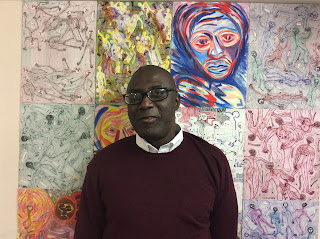
Vlog: Amateur Ghanaian artist and his fascination with everyday people

Image
Robert Badu is an amateur artist whose gift has been nurtured by a fascination with Asante cultural symbols (such as Asante gold weights ), vibrant colours and everyday people. Robert Badu comes from the Mampong Royal Family ©  MisBeee Writes In the vlog below, Badu explores his early influences and explains why sheer determination meant his dyslexia was not a hindrance to him becoming an artist. Badu is a trained teacher (not in art) although he has been known to teach the subject when the need has arisen. He currently works as a corporate security guard but has hopes of pursuing his artistic passions full time. He boasts a healthy following on social media which includes US musicians Arrested Development – one of Badu’s favourite groups whose hit song ‘Everyday People’ inspired his work. The piece below 'The Politician' shares an uncanny resemblance to US president Donald Trump. But this is only coincidental said Badu as the painting was produced in 2012...

Roots and culture II: The enduring legacy of Brazil's Tabom in Ghana

Image
British-Ghanaian journalist and videographer Kai Lutterodt can trace her ancestry back five generations to the Tabom people, (check part one 'Roots and culture I' here ).   The Taboms were an Afro-Brazilian community of former slave returnees, mainly of Yoruba descent, that migrated to Nigeria initially and then settled in Ghana*. © Kai Lutterodt (centre) is flanked by Carnival-goers in Bahia 2013 The community derived its name from the Portuguese phrase: ‘esta bom’ or ‘ta bom’ for short, which means it is good. As the story goes, the returnees could not speak the Ga language spoken in Accra, or English so when locals asked them questions, their response was typically: ‘Ta bom’ – hence their name. Since then, the Tabom name has undergone a further transformation to Tabon, which is thought to be francophanisation of the name. Spiritual journey For Lutterodt, the exploration of her Tabom heritage was powerfully spiritual and gave her an opportunity to connec...

Roots and culture: A personal exploration of Ghana's Tabom heritage

Image
The story of how the Tabom people (an Afro-Brazilian community of former slave returnees mainly of Yoruba descent*) that migrated from Brazil Kai Lutterodt can trace her ancestry back five generations to Brazil's Tabom people ©  MisBeee Writes to West Africa has long fascinated me. Those of you who know me know of my love affair with Brazil, my search for its Twi-speaking community and my crazy experiences in the country over four trips. So, you can imagine my utter excitement when I found a living descendent of the Afro-Brazilian community right under my nose in London. Her name is Kai Lutterodt. She's British-Ghanaian, a recent journalism graduate and her two-part story is fascinating. Ancestral roots Lutterodt first learnt about her Tabom roots from her dad when she was eight years old. " I always considered it to be this exotic side that I had. It wasn’t until I became older that I explored it a bit further and I found out that it was a lot to do ...

Black canvas, white letters - why discourse on slavery is always relevant

Image
For me, this striking image typifies just how pivotal we Black people have been in shaping the modern world. In a single shot, we see the depths to the subjugation and disrespect shown to men and boys from what is now modern-day Nigeria. These men were deemed to be no better than paper and used as such to communicate a festive message. How insulting! A 1923 Christmas picture of staff at the African Oil Nuts Company & Miller Brothers in Badagry, Nigeria © Image of Empire Birth of a nation It is a funny dichotomy. We have the source of mankind, born on African soil, shipped abroad or enslaved on their land; mentally and physically beaten to accept that they were nothing more than a commodity. And yet without our acquiescence, tenacity, and skill nothing that we value in terms of modern-day development would be here. Trump tells the world he wants to make America great again and the nostalgic hark back to 'Great' Britain all smack of a period when indus...

Re-telling the single story on Traditional African Religions

Image
Golden artefacts from Ghana's Asante region (1920) (c) Musée du quai Branly, Paris Star 100 - a Ghana-focused diaspora network based in London - invited me to share my thoughts on the role of traditional beliefs in Ghanaian culture. The discussion, on 30 September 2016, was entitled Traditional Beliefs and Customary Law, at the Museum of the Order of St John in Clerkenwell, London. The topic is something I have been exploring for some time, particularly during my time living in Ghana. I wanted to share with you my short presentation and invite you to share your views..... Here is an abridged version of a story I wanted to share with you: In the beginning, the universe consisted only of the sky, the water, and the wild marshlands.   God (Obatala) believed that the world needed more and asked the ruler of the sky and creator of the sun – the supreme God - (Olorun) for permission to create solid land on Earth. This lesser God made clay figures in the li...

Afrobeat jazz collective out to explore music across the African continent

Image
Afrobeat jazz collective KOKOROKO is in the process of writing and recording their own original compositions. Left to right: Cassie Kinoshi, Sheila Maurice-Grey and Richie Seivwright part of KOKOROKO afrobeat jazz collective © KOKOROKO The seven-strong ensemble have been playing renditions of timeless West African classics such as 'Kai Wawa' across London since 2014. (The song is a traditional Hausa war chant that was produced by the Mercury Dance Band in Kade, Ghana).  But now they are looking to produce original work which will likely be out later this year, KOKOROKO's alto saxophonist Cassie Kinoshi told MisBeee.  "We feel that now is the right time to present our own message through music," she said. Multicultural roots The band's music is reflective of their mixed cultural backgrounds. Their heritage covers England, Grenada, the Grenadines, Guinea-­Bissau, Jamaica, Nigeria, Sierra Leone and Zambia. Their  musical influences are equa...